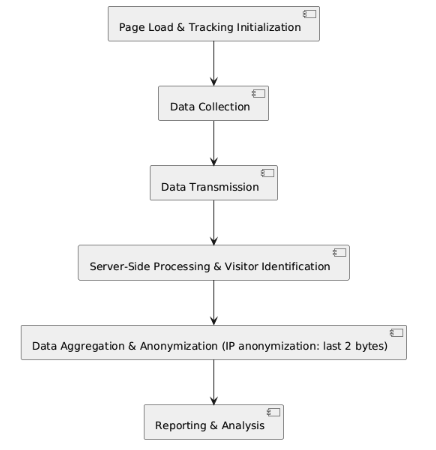
Page Load & Tracking Initialization
The visitor's browser loads a web page that contains the Matomo tracking code.
The tracking script is configured so that it does not read or write any cookies in cookieless mode.
Data Collection
The script collects key information such as the page URL, referrer, timestamp, IP address, and user agent.
Unlike traditional methods, cookies do not store a long-term identifier on the user's device.
Data Transmission
The collected data is sent to the Matomo server via an HTTP request (GET request with query parameters).
The request contains all tracking information but omits any cookie data.
Server-Side Processing & Visitor Identification
Upon receiving the request, the server analyzes the data and uses available parameters (such as IP address, user agent, and timestamp) to determine the visitor's identity.
Since no cookies are used for persistent identification, Matomo generates a config_id to recognize returning visitors within a limited time frame.
The config_id is a hash value derived from a combination of reasonably stable properties of the visitor's environment, such as:
- User Agent (browser and version)
- IP address (with anonymization)
- Browser settings (such as language and screen resolution)
Unlike cookies, the config_id does not persist beyond the session and is not uniquely tied to a user. Instead, it provides a best-effort approximation of individual visitors.
Since browser configurations can change, config_id is not a perfect identifier and may result in a certain degree of duplication or misidentification.
This method helps group visits without storing personally identifiable information (PII), ensuring compliance with data protection regulations.
Data Aggregation and Anonymization
The server aggregates the incoming data into sessions and general visitor statistics.
Anonymization steps include removing the last two bytes from the IP address to protect personal data, anonymizing referrers, and removing non-UTM parameters from landing pages.
The anonymized data is stored in our database. Each customer's data is stored separately.
Reporting & Analysis
The aggregated data is made available to our talentsconnect home and users via APIs.
Was this article helpful?
That’s Great!
Thank you for your feedback
Sorry! We couldn't be helpful
Thank you for your feedback
Feedback sent
We appreciate your effort and will try to fix the article